
AI Search Is Rewriting Brand Visibility—But Not Your Entire Strategy
Obah Sylva
December 5, 2025
1. Treat AI Answers as Featured Snippets on Steroids
AI engines like Perplexity, ChatGPT Search, and Grok pull concise, authoritative summaries from trusted sources. To appear in those summaries:
- Structure content for direct answers. Use clear headings, bullet points, and schema markup (FAQ, HowTo, Article) so crawlers can extract exact responses.
- Target zero-click intent. Answer the full user journey in one place: problem → solution → proof → next step.
- Refresh cornerstone pages quarterly. AI models favor fresh, comprehensive sources over outdated blog posts.
Quick win: Run a content audit. Identify your top 20 organic landing pages and add a “TL;DR” summary box at the top with structured data.
2. Optimize for Entity-Based Understanding
Modern AI search doesn’t just match keywords—it understands entities (people, places, brands, concepts) and their relationships.
- Build topical authority. Create content clusters around core entities (e.g., “sustainable fashion” → subtopics: materials, supply chain, certifications).
- Use knowledge graphs. Submit your brand to Wikidata, ensure consistent NAP (Name, Address, Phone) across directories, and interlink related content.
- Earn mentions in AI training data. Get featured in industry reports, HARO responses, and expert roundups—sources AI models scrape heavily.
Quick win: Create an “About [Entity]” page for every product line, linking to case studies, patents, and third-party reviews.
3. Create AI-Native Content Formats
Some content performs better in generative responses than traditional blog posts.
Format | Why It Works | Example |
|---|---|---|
Comparison tables | Easy to parse and cite | “CRM Showdown: HubSpot vs. Salesforce vs. Zoho” |
Step-by-step frameworks | Matches “how-to” intent | “The 7-Step GAIO Framework for Ecommerce Brands” |
Data-rich visuals | High shareability + citation value | Interactive ROI calculators, industry benchmarks |
Quick win: Convert your best-performing blog post into a downloadable PDF checklist with embedded schema.
4. Amplify Earned Signals AI Can’t Ignore
AI models weigh E-E-A-T (Experience, Expertise, Authoritativeness, Trustworthiness) more than ever.
- Author bios with credentials. Link to LinkedIn, certifications, and speaking gigs.
- Third-party validation. Encourage case studies, G2 reviews, and analyst mentions.
- Community proof. Highlight user-generated content, subreddit discussions, or Slack community wins.
Quick win: Add a “Featured In” section to your homepage with logos from reputable publications AI models trust (Forbes, TechCrunch, etc.).
5. Monitor AI SERPs Like Traditional Ones
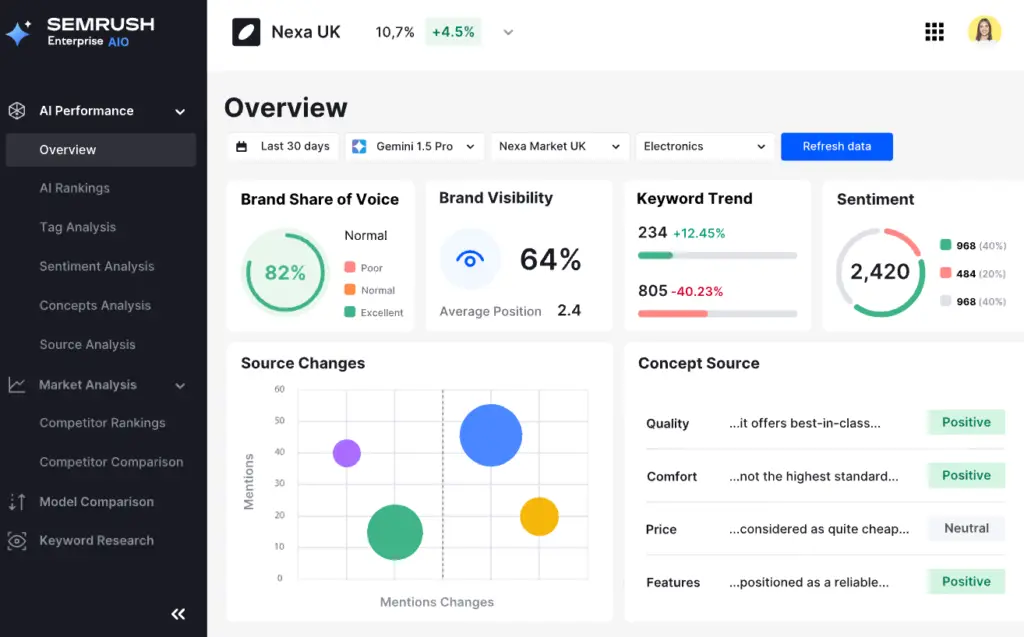
New tools track AI visibility the way SEMrush tracks Google.
- Track answer box appearances. Use tools like AI Search Observer or custom GPTs to monitor citations.
- Watch for cannibalization. If your content appears in AI answers but traffic drops, you may need deeper, unique insights.
- Test prompt variations. Query AI engines with branded + unbranded terms to see representation gaps.
Quick win: Set up weekly alerts for your brand name + “best,” “vs,” or “how to” in Perplexity and ChatGPT.
The Bottom Line
AI search isn’t replacing SEO—it’s evolving it. The brands that win will be those that:
- Speak the language of machines (structured, entity-rich content)
- Earn trust at scale (E-E-A-T signals)
- Deliver undeniable value (zero-click answers + deeper dives)
Start with one cluster, one format, one signal. The compound effect will position you in AI answers long before 2027 arrives.Your existing SEO foundation isn’t obsolete—it’s the launchpad.